The Ancestral Roots of Central Italian Viticulture: The Tarquinia DOC and the Etruscan Heritage
Executive Summary
For the modern sommelier, importer, and connoisseur of Italian excellence, the concept of Made in Italy is inseparable from the concept of terroir—the profound connection between soil, climate, history, and human ingenuity. While the Roman Empire famously exported wine culture throughout Europe, the foundational architecture of viticulture in Central Italy was pioneered centuries earlier by the Etruscans. Between the 8th and 4th centuries BC, this advanced pre-Roman civilization transformed wine production and maritime trade into their primary source of wealth and cultural prestige.
Today, this millennial heritage is preserved in the unique volcanic and tufaceous terroirs of Southern Etruria, specifically within the strict production parameters of the Tarquinia DOC. This article provides a comprehensive oenological and historical analysis of these exceptional wines, illustrating their technical characteristics, genetic lineages, and strategic importance for the global promotion of authentic Italian production.
Technical Analysis of the Tarquinia DOC Terroir
The organoleptic profiles that define the wines of the Tarquinia DOC are the direct result of a highly specific macroclimate and pedological composition unique to the Tuscia region (the territory surrounding Viterbo and coastal Lazio).
Soil Composition
The area is characterized by a complex matrix of volcanic soils and ancient tufa stone layers. These soils are naturally rich in essential macro- and micronutrients, including potassium, phosphorus, and magnesium. The high porosity of tufa allows for excellent water drainage while forcing grapevine root systems to delve deep into the mineral strata, yielding wines with a pronounced back-end salinity and high structural longevity.
Microclimate
The terrestrial heat retention of the dark, volcanic soils is balanced by a constant maritime influence from the Tyrrhenian Sea. The diurnal temperature variations—driven by cooling evening sea breezes—slow the ripening process of the grapes, preserving natural titratable acidity and concentrating complex aromatic precursors within the grape skins.
Ampelographical Archaeology: The Genetic Legacy
Modern grapevine genetics and DNA profiling confirm that the varietals cultivated in Central Italy today retain a direct, unbroken lineage to the wild vines (Vitis vinifera sylvestris) originally domesticated by Etruscan agriculturalists over 2,500 years ago.
       [ Vitis vinifera sylvestris ]  <-- Wild Forest Vines
                     |
         ( Etruscan Domestication )
                     |
   +-----------------+-----------------+
   |                                   |
[ Direct Genetic Heirs ]     [ Tarquinia DOC Varieties ]
  - Sangiovese                 - Procanico (Trebbiano)
  - Lambrusco                  - Grechetto
  - Ciliegiolo                 - Malvasia del Lazio
  - Aleatico                   - Montepulciano
1. Direct Genetic Heirs
- Sangiovese & Ciliegiolo: Germplasm analysis confirms that these pillars of Italian red viticulture stabilized in the Etruscan heartland during antiquity.
- Lambrusco: Etymologically derived from the Latin labrusca (wild vine), its forest-born progenitors were systematically selected and cultivated in ancient woodlands.
- Aleatico: A highly aromatic red variety, historically perfected by pre-Roman cultures to produce dense, sweet, and structurally concentrated vintages.
2. The Core Varieties of the Modern Tarquinia DOC
- Procanico (Trebbiano Toscano): Known historically as Trebula. This rustic, highly adaptive white grape forms the structural base of the region’s white wines, valued for its ability to preserve high tartaric acidity and convey mineral tension.
- Grechetto: A premium white variety that produces high-extract, sapid, and structured wines, echoing the texturally dense descriptions recorded by classical authors.
- Malvasia (del Lazio & Toscana): Aromatic white varieties utilized to introduce intense floral aromatics, body, and mid-palate weight to local blends.
- Montepulciano & Sangiovese: These varieties form the indispensable phenolic backbone for the red and rosato expressions of the DOC, guaranteeing an indissoluble link to the rural traditions of Southern Etruria.
Historical Context: “Vite Maritata” and the Elite Symposium
The technical excellence of modern Italian wine is rooted in historical cultivation methods that treated the vineyard as an ecosystem.
The “Married Vine” Architecture
Unlike the modern Guyot or Cordon systems, the Etruscans invented “vite maritata” (the married vine). Rather than planting vines in low rows, they trained them to climb living support trees, such as elms or poplars.
Oenological Purpose: This high canopy architecture lifted the fruit zones far above the soil. This effectively minimized the risk of fungal diseases, grey rot (Botrytis cinerea), and ground frost induced by nocturnal humidity, ensuring optimal health and phenolic ripeness.
The Culture of the Symposium
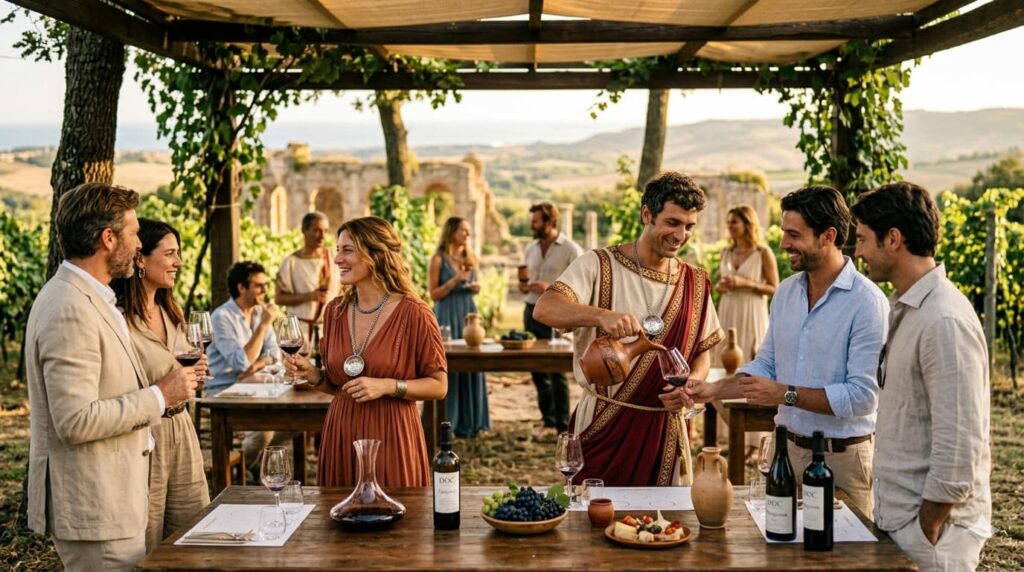
In Etruscan society, wine was the center of social, religious, and economic life. It was celebrated in the symposium—a highly sophisticated ritual banquet.
Significantly, and in sharp contrast to ancient Greece and Rome where women were strictly excluded from public consumption, Etruscan women participated as equals in these symposia. Reclining on luxurious triclinia (banquet couches) alongside men, they drank wine freely, illustrating a culture that viewed wine as a symbol of shared luxury, freedom, and high social status.
Technical Specifications and Sensory Profiles
1. Dry and Frizzante White Expressions
The crisp acidity and mineral-saline core function as excellent palate cleansers for lipids and sweet-leaning proteins.
- Coregone del Lago di Bolsena (Grilled or alla Bolsenese): The sapidity of Tarquinia Bianco cuts through the natural oils of this premium freshwater lake fish.
- Acquacotta Viterbese: A traditional vegetable soup featuring chicory, poached egg, and stale crusty bread. The natural effervescence of the Bianco Frizzante lifts the palate after each rich spoon.
- Medium-Aged Pecorino Romano DOP: The salt and mineral matrix of the wine counteracts the sweet, high-fat density of the sheep’s milk cheese.
2. Structured Red Expressions
The robust phenolic structure and polished tannins require dense proteins and wild game.
- Wild Boar Cacciatore or Jugged Hare: The dark berry notes and spicy, peppery profile of the Tarquinia Rosso complement the intense, earthy flavors of wild game.
- Porchetta di Tarquinia / Vallerano: Slow-roasted whole pork seasoned with wild fennel and black pepper. The warmth and alcoholic body of the Sangiovese-Montepulciano blend emulsify the rich fats.
- Fagioli del Purgatorio di Gradoli (with Pork Rind): A dense stew of local white beans and pork. The structural tannins effectively dry the palate from the starch and protein coatings.
3. Amabile (Semi-Sweet) White and Red Expressions
The residual sugar profile ($30 \rightarrow 50\text{ g/l}$) demands pairings based either on aromatic harmony or sharp, savory contrasts.
- Tozzetti di Viterbo (with Cimini Mountains Hazelnuts): The classic regional hard biscotti. Tarquinia Bianco Amabile mirrors the sweetness without overpowering the delicate oil aromatics of the Roman hazelnut.
- Frittelle di Tarquinia (Aniseed or Cauliflower): Traditional festive fritters. The Amabile style balances the frying richness while accentuating the sweet, aromatic notes of anise.
- Extra-Aged Pecorino or Blue Cheeses: A high-end contrast pairing. The residual sweetness of Tarquinia Rosso Amabile tames the sharp, pungent bite of the cheese’s advanced proteolysis.
Frequently Asked Questions (FAQ)
Q1: How did ancient Etruscan wine differ analytically from modern styles?
A1: Etruscan wine was characterized by high density and high alcohol. It was never consumed pure, but served as a concentrate diluted with fresh water or purified seawater, and infused with natural preservatives such as honey, pine resins, spices, and grated cheese. It was aged in resin-coated clay pithoi, which imparted a distinct balsamic profile.
Q2: What are the main technical benefits of the historical “Vite Maritata” system?
A2: By using living trees (elms or poplars) as structural supports, the Etruscans lifted the grape clusters high off the ground. This improved ventilation, optimized sun exposure, and protected the fruit from ground-level moisture, rot, and frost, ensuring high fruit health before the advent of modern chemistry.
Q3: What role did gender equality play in the ancient wine trade of Central Italy?
A3: Unlike contemporary Greek and Roman cultures that prohibited women from consuming wine or entering public banquets, Etruscan society included women as equal participants in the symposium. Women regularly reclined on triclinia alongside men and drank wine freely, cementing wine as a shared symbol of luxury and social freedom.
Q4: Which modern grape varieties possess verified genetic links to this pre-Roman history?
A4: DNA profiling shows that Sangiovese, Ciliegiolo, and Lambrusco (derived from the wild labrusca vine) have ancient genetic roots in this specific region. Furthermore, white varieties like Trebbiano (ancient Trebula) and Grechetto continue to replicate the sapid, highly mineral styles favored by the ancients.
Commercial Glossary
- Amabile: An official Italian oenological designation for a semi-sweet wine containing between $30\text{ and }50\text{ grams}$ of residual sugar per liter.
- Amphora: A classic two-handled ceramic vessel featuring a pointed base, engineered by the Etruscans for efficient stacking within the hulls of maritime cargo ships during Mediterranean trade.
- Pithoi: Massive, wide-mouthed earthenware storage jars used in antiquity for bulk wine fermentation and preservation, lined with pine resin for waterproofing.
- Symposium: A ritualized aristocratic banquet centered around the shared consumption of wine, intellectual debate, and cultural celebration.
- Triclinium: A formal ancient dining configuration consisting of three couches arranged around a central table, where guests reclined during elite banquets.
- Vite Maritata: (Literally “Married Vine”) An ancient agro-forestry training system where a grapevine is physically integrated into a living host tree for structural support.
- Vitis vinifera sylvestris: The wild, dioecious ancestor of the modern European grapevine (Vitis vinifera sativa), native to the forests of the Mediterranean basin.
Travel – elite tourism experience
The territory of Southern Etruria, Tarquinia, in particular with its DOC wines, history and ancient artifacts to admire, is worth while visiting in person to live this unique continuity of history. This is not merely a product; it is liquid history born from volcanic soil and a 2,500-year-old culture of celebration and refinement, a true experience to live also in person and while sipping it.
For high-net-worth travelers and luxury wine importers visiting Rome, explore the Tarquinia DOC vinyards, way beyond wine it represents the ultimate insider journey into the authentic, pre-Roman origins of Italian viticultural excellence.
TO LIVE A LIVE WINE AND ETRUSCAN EXPERIENCE www.RomaLuxury.com